
Table of Contents
Why Cuenca’s Historic Center Belongs on Your List
Cuenca’s historic center, officially the Historic Centre of Santa Ana de los Ríos de Cuenca, earned UNESCO World Heritage status in 1999 because it is one of the best-preserved Spanish colonial towns in South America. What draws visitors is not just a handful of monuments but an enduring urban fabric: a compact grid of cobbled streets and plazas, timber balconies and carved doorways, churches with layered baroque and neoclassical ornament, and riverside promenades that shape everyday life.
Architecture to Look For: Styles, Details and Materials
The city’s architecture is a conversation between Spanish colonial planning and local Andean craftsmanship. Walk slowly and you’ll notice recurring elements:
- Wooden balconies: intricately carved and often painted, projecting over narrow streets and providing shade and privacy.
- Red-tile roofs and internal patios: many old houses keep the Andalusian patio, now planted with gardens or converted into boutique hotels.
- Stone and plaster facades: churches and civic buildings show a range from baroque exuberance to restrained republican forms.
- Ironwork and portals: wrought-iron grilles and heavy wooden doors with metal studs are common on civic mansions and convents.
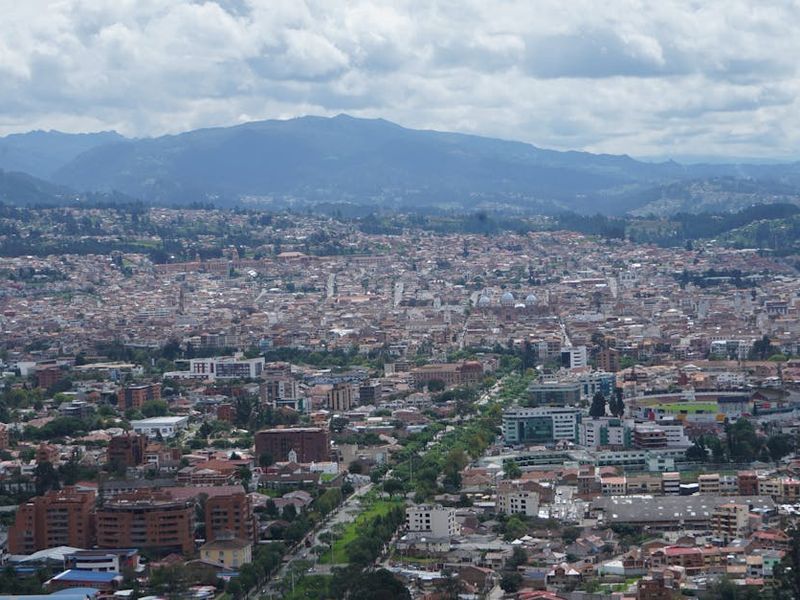
- Blue domes: the New Cathedral’s cobalt domes are one of Cuenca’s most recognizable silhouettes—visible from several vantage points.
Start Here: Parque Calderón and the Cathedral Domes
Most itineraries begin at Parque Calderón, the heart of the historic center and a social hub framed by cafés, municipal buildings and churches. From the park you can admire the Catedral de la Inmaculada Concepción—often called the New Cathedral—with its striking blue glazed-tile domes. Early morning and late afternoon produce the best light for photos and cooler temperatures for walking.
Practical tip
Plan to arrive early to avoid crowds and catch the domes in warm light. Many rooftop cafés and terraces around the park offer clear views—ideal for skyline photos and city orientation.
Must-See Monuments and Museums
Beyond the cathedral, the historic center contains dozens of churches, convents and museums set within restored colonial buildings. A sensible route includes:
- Museo Pumapungo – An ethnographic museum with Inca-era ruins and a small botanical garden near the Tomebamba River, excellent for context on pre-Columbian and colonial layers.
- Museo de las Conceptas – Housed in a former convent, this museum displays religious art and textiles tied to Cuenca’s ecclesiastical history.
- San Francisco and El Sagrario churches – Two of the city’s oldest religious sites with intricately ornamented altars and plazas that reveal evolving architectural tastes.
- Museo del Banco Central – For those interested in archaeology and regional history, its collections help situate the city within Andean civilizations.
Practical tip
Small museums in Cuenca frequently ask for cash payment for entry and may close for a lunch break. Carry small bills, and check opening hours in advance—many close mid-afternoon or on Mondays.
Walking Routes: Half-Day to Three-Day Plans
Cuenca’s compact size rewards exploration on foot. Here are three flexible itineraries depending on your available time:
- Half-day: Start at Parque Calderón, visit the New Cathedral and the nearby churches, then stroll along the northern bank of the Tomebamba River for views of terraces and balconies.
- Full day: Add Museo Pumapungo and the Museo de las Conceptas, stop for a traditional lunch of hornado or mote pillo at a local market, then end at the Mirador de Turi for dusk panoramas.
- Three days: Take guided tours of historic houses converted into boutique hotels, explore the artisan markets for ceramics and panama hats, and set aside time for nearby haciendas or the Cajas National Park for a change of scenery.
Riverside Promenades and Bridges
The Tomebamba River traces the contours of the historic center, defining terraces, pedestrian promenades and scenic bridges. The riverside gardens—a 19th- and 20th-century addition—offer an opportunity to see how the city adapted its colonial layout to modern public space. Walk both banks to observe the façades from different angles; the rivers often mirror the colorful tiles and wooden overhangs for striking photos.
Practical tip
Pay attention to small bridges and alleys: they are often the quietest places to appreciate decorative tiles, door knockers and the bloom-filled patios of private homes.
Adaptive Reuse: Hotels, Restaurants and Cultural Spaces
One remarkable aspect of Cuenca’s UNESCO zone is how historic buildings have been repurposed. Colonial mansions now house boutique hotels, art galleries, tapas bars and design shops. These restorations maintain façades and interior courtyards while updating plumbing and heating—giving visitors a chance to experience historic ambiance with modern comfort.
Practical tip
If you want an immersive stay, look for lodgings that advertise restored patios or rooftop terraces. Read reviews to confirm the restoration quality and noise levels—the center is lively into the evening.
Photography and Respectful Visiting
Architectural photography in Cuenca is rewarding, but certain sites—particularly active churches and convents—restrict flash or tripod use and may limit photography inside. Always ask permission before photographing people, especially inside markets or family-run workshops. Avoid touching carved woodwork or tiled façades; many features are fragile and centuries old.
Practical tip
For the best dome and skyline shots, head to Mirador de Turi or a hotel terrace at sunrise. Use a mid-range zoom lens for facades and a wide-angle for plazas, but be mindful of other visitors when setting up.
Seasonal Considerations and Practicalities
Cuenca sits at roughly 2,550 meters (8,400 feet) above sea level, so sun intensity and cooler nights are part of the experience. The climate is temperate year-round with a wetter period typically from October to May. High season is June to September when skies are drier and many travelers visit.
- Health: Allow time to acclimatize if you’ve come from sea level; drink water and avoid heavy exertion on your first day.
- Currency and language: Ecuador uses the U.S. dollar. Spanish is the dominant language; basic Spanish phrases will make interactions smoother.
- Footwear: Cobblestones are uneven—bring comfortable, supportive shoes.
Local Flavors Near the Historic Quarter
Architecture and food often go hand in hand. Traditional Cuencan cuisine is available in markets and family-run eateries near the plazas. Try llapingachos (potato pancakes), hornado (roast pork), and mote (hominy) in a cozy courtyard setting—many restaurants keep historic interiors that enhance the meal.
Practical tip
Markets such as the Central Market offer inexpensive, authentic meals but can be busy and lively. For full dining experiences, look for restaurants advertising courtyard dining—these venues often preserve historical elements like wooden beams and tile floors.
Responsible Tourism: How You Can Help Preserve Cuenca
Cuenca’s charm comes from centuries of continuous habitation and careful stewardship. As a visitor you can support preservation by following a few simple practices:
- Respect signage and barriers around restoration sites and archaeological areas.
- Choose locally owned tours, eateries and shops to keep economic benefits in the community.
- Minimize noise and litter—especially in residential zones around plazas.
- Support museums with admission fees and consider donations when available.
Where to Learn More and Find Guided Options
If you want deeper historical context, guided walking tours and specialized museum tours are widely available. Look for certified local guides who can explain construction techniques, colonial social history, and the evolution of neighborhoods. Many universities and cultural centers also run lectures and temporary exhibits that illuminate Cuenca’s architectural layers.
Final Suggestions for an Enriching Visit
Take your time. Cuenca’s appeal is not in ticking off a short list of sights but in lingering—sipping coffee by a plaza, watching laundry dry from a carved balcony, peering into a sunlit patio. Approach the city as a living museum: its streets preserve the past while serving the rhythms of modern life. With thoughtful planning and a bit of curiosity, you’ll leave with a richer understanding of how architecture shapes culture and community in this UNESCO-listed Ecuadorian city.
Happy exploring—step gently on those cobbles, and enjoy the views from the blue-domed skyline to the river’s reflective banks.